Blog

Onward to the Uni Project

We’re hard at work on the Uni now, and you can read all about it on the Uni web site, which picks up where this blog leaves off.

Below, the Street Lab blog looks back at our previous projects, like a community film series in a vacant lot, performing arts rehearsals in public space, and the Storefront Library. It also includes some posts about the early development of the Uni.

Read on, and see you in the Uni.

Films at the Gate: on to the weekend

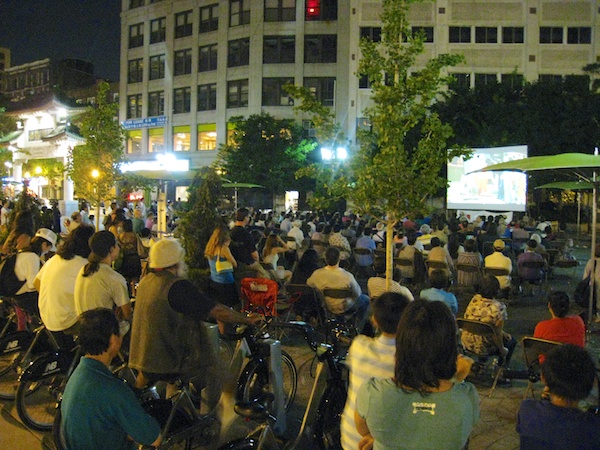
The first two nights of Films at the Gate have been wonderful—not an empty seat in the “house.” If you are coming down this weekend, feel free to bring your own seating so we can offer more chairs to seniors and kids.

For the first time in seven years, Leslie and I will have to miss the weekend finale, but you’ll be in the very capable hands of Jean Lukitsh, Iris Tan, ACDC staff, and some wonderful community volunteers. Have a great time, and please send us photos!


Also this weekend, enjoy some performances by Wah Lum Kung Fu Athletic Association and Bow Sim Mark Tai Chi Arts Association. Here’s some background on Bow Sim Mark from Jean Lukitsh, our curator:

In 1975, Grandmaster Bow Sim Mark established the Chinese Wushu Research Institute in Boston’s Chinatown. She was the first to use the term Wushu for teaching in the U.S. For several decades, Master Mark concentrated on the areas of teaching, publication, performance and choreography. She was named as the 1994 and 1996 “Woman of the Year” by Inside Kung Fu magazine, and Black Belt magazine has called her one of the “Most Influential Martial Arts Masters of the Twentieth Century.” The Bow Sim Mark Tai Chi Arts Association (1995) has twenty-three branches in the US, Europe, Hong Kong, and other countries. It has been Grandmaster Mark’s objective to emphasize the artistic aspect of Tai Chi Chuan. It is her passion to promote Tai Chi as an art and to continuously refine this art form. Her son Donnie Yen is one of the biggest action stars in China. On June 19 2011, she was featured in a cover story by the Boston Globe magazine: The Way of the Ribbon and the Sword.

Films at the Gate 2012: starts Thursday!

What began seven years ago on a vacant lot continues on the Greenway: Films at the Gate returns for a seventh year, starting tomorrow, Thursday 8/23. Join us as we create a free, outdoor theater, showing Kung-Fu and classic Chinese-language films under the stars, next to the Chinatown Gate.

Film schedule and details here. Movies roll at 8PM, and there are walking tours and performances beforehand.

On Saturday night, for example, check out a performance by Wah Lum Kung Fu Athletic Association, under the direction of Master Bob Rosen. Here’s some background on Wah Lum Kung Fu form Jean Lukitsh, our curator:

Wah Lum Kung Fu of the U.S.A. was started by Grandmaster Chan Pui in Boston’s Chinatown over 35 years ago. Sifu Bob Rosen has been instructing in the martial arts since 1972 and is the Chief Instructor of the Wah Lum Kung Fu Athletic Association, established in 1984. He is the first non-Asian instructor to operate a school in Boston’s Chinatown, and he has been a 7th generation student of Grandmaster Chan since 1976. In 1989 he was a member of the first non-Asian group to study Kung Fu in the Shaolin Temple. In 1994 he won a Gold Medal in the Open Weapons division at the Beijing International Tournament in China. In 2001 he was the senior coach for the Wah Lum team at the Shaolin Wushu competition in Zhenghou, China, which won numerous awards. He has coached many students who have been successful in fighting, forms, and weapons at local, national and international events.

In addition to establishing himself as a traditional instructor of the Wah Lum System, Sifu Rosen has studied Tai Chi Chuan, Iron Palm (breaking), and Lion Dance from Grandmaster Chan and other U.S. and China based Masters. He has been invited to participate as a judge and to demonstrate at various Martial Arts events around the country.

Films at the Gate: Red Fists, the Man Behind SHAOLIN TEMPLE

Films at the Gate starts is almost here! Check out the 2012 schedule chosen by curator Jean Lukitsh. Here’s another terrific post from Jean about one of her picks SHAOLIN TEMPLE. Thanks Jean!


To say that Cheung Sing-yim (1935- ), the director of Jet Li’s debut film THE SHAOLIN TEMPLE, is relatively unknown is putting it mildly. This is a guy who is not only responsible for Li’s career, but also that of a number of other successful martial arts actors. His proteges include Wu Jing (Donnie Yen’s opponent in the legendary alley fight in SHA PO LANG, aka KILL ZONE, 2005) and Yu Chenghui, who can currently be seen in the arthouse hit THE SWORD IDENTITY (2011). And we don’t even really know his name. He’s also been credited in English as Chang Hsin Yen, Cheung Yam-yin, and Zhang Yinyan. (In Chinese, his name is 张鑫炎).

Cheung began his film career as an editor in Hong Kong in the 1950s. He worked on low budget Cantonese opera and martial arts films from 1952 to 1957. The Wong Fei-hung series, which was based on the life of a southern Chinese kung fu master, was very popular at that time, and Cheung edited at least a half dozen of those films, including HOW WONG FEI-HUNG FOUGHT FIVE DRAGONS SINGLE-HANDEDLY and WONG FEI-HUNG WINS THE DRAGON BOAT RACE (both 1956). In 1958, he went to work for The Great Wall Movie Enterprises Ltd, the premiere left wing studio in Hong Kong.

Cheung & Li on a SHAOLIN TEMPLE set

The political turmoil that rocked China after World War II was felt in Hong Kong too. Refugees from Shanghai, China’s pre-war Hollywood, had flocked to the British colony. Some of those filmmakers were staunch socialists, and the studios they founded reflected their views. Of course, their films had to compete in the marketplace too. In China, the Communists banned kung fu and gangster films. In Hong Kong, the leftist studios could bend the rules a little. The first film Cheung Sing-yim edited for Great Wall was a gangster flick, THE GREEN SWAN NIGHTCLUB (1958), that starred Hsia Moon, the “Crown Princess” of the studio. In 1961, Cheung is credited as assistant director on the Great Wall production THE LADY RACKETEER. As action films became more important to the studio’s bottom line, Cheung’s expertise in assembling fight scenes was in high demand. In 1966, he directed THE JADE BOW, a classic swordplay story, for Great Wall. To handle the action choreography, he brought in Lau Kar-leung and Tong Kai, who would go on to create some of the best kung fu movies of the 1970s at the Shaw Brothers studio. Cheung obviously has always had an eye for good kung fu.

Cheung Sing-yim continued to direct both dramas and the occasional action film for the Great Wall studio, and he may have never been more than a footnote in the history of Hong Kong cinema had fortune not smiled on him in the early 1980s. A consortium of left wing studios, including Great Wall, approached the Chinese government with a bold proposal – to film a kung fu movie at the real Shaolin Temple, the “birthplace of kung fu.” Cheung was tapped to helm the project, and when investors demanded “real kung fu” in keeping with the authenticity of the site, he cast the film with tournament champions and coaches from the national Chinese martial arts teams. The gamble paid off, as THE SHAOLIN TEMPLE (1982) was an international success. Cheung also directed the 1984 SHAOLIN TEMPLE sequel and a Chinese swordplay cult classic called YELLOW RIVER FIGHTER (1988), starring Yu Chenghui. In 1996, he co-directed TAI CHI II with the legendary kung fu director Yuen Woo-ping. This was the film that introduced Wu Jing to the screen. He has been active as a producer in both film and TV projects in Hong Kong and China in recent years, specializing in martial arts projects. -Jean Lukitsh

Selected filmography:
1956 HOW WONG FEI-HUNG FOUGHT FIVE DRAGONS SINGLE-HANDEDLY, editor
1961 THE LADY RACKETEER, assistant director
1966 THE JADE BOW, co-director (with Fu Chi)
1971 THE PATRIOTIC KNIGHTS, director
1980 WHITE HAIRED DEVIL LADY, director and screenwriter
1982 THE SHAOLIN TEMPLE, director
1984 KIDS FROM SHAOLIN, director
1988 YELLOW RIVER FIGHTER, director
1991 RED FISTS, producer
1996 TAI CHI II, co-director (with Yuen Woo-ping)
2005 SEVEN SWORDSMEN (TV series), producer


Films at the Gate: Jimmy Wang Yu, One-Armed Boxer

Films at the Gate is only a few weeks away, and our curator Jean Lukitsh has been hard at work. The 2012 schedule is available here. Here’s a post from Jean about one of her selections: ONE ARMED BOXER VS. THE FLYING GUILLOTINE. Thanks Jean!


Wang Yu is one of the first modern kung fu stars. In the mid-1960s, before Bruce Lee made his iconic films, Wang appeared in martial arts movies for the Shaw Brothers studio in Hong Kong. The Shaw action director Chang Cheh was working in a new cinematic style that owed less to Chinese opera and more to the groundbreaking films of Kurosawa and Peckinpah. Wang Yu starred in THE ASSASSIN (1967), THE ONE-ARMED SWORDSMAN (1967), THE GOLDEN SWALLOW (1968), and RETURN OF THE ONE-ARMED SWORDSMAN (1969) under Chang’s direction. In 1970, Wang Yu wrote, directed, and starred in THE CHINESE BOXER (1970), a bona fide hit that brought him an international following.

At around the same time, his relationship with the Shaw studio blew up over accusations of contractual breaches and lawsuits. After breaking with the Shaws, Wang Yu relocated to Taiwan and continued to make films there. Shaw Brothers had maintained second unit locations and crews in Taiwan for years, so Wang Yu continued to work with his old friends from the Shaws, like the brothers Lau Kar-leung and Lau Kar-wing who choreographed Wang’s 1976 film ONE ARMED BOXER VS. THE FLYING GUILLOTINE.

From the original ONE ARMED BOXER (1971) to Sammo Hung’s MILLIONAIRE’S EXPRESS (1986), Wang Yu carved out a solid career as a kung fu hero in mostly low budget films. He reprised his One-Armed Swordsman and One-Armed Boxer roles several times. He worked with Jackie Chan on 1976’s KILLER METEORS, with George Lazenby on THE MAN FROM HONG KONG (1975), and even with Chang Cheh again in 1984’s SHANGHAI 13. Last year he came out of a two decade retirement to co-star with Donnie Yen and Takeshi Kaneshiro in Peter Chan’s WU XIA (DRAGON), which will get a US release later this year from The Weinstein Company.

Wang Yu was born in Jiangsu, China, in 1943. He was recruited by the Shaw Brothers studio in 1963 after making a name for himself as a swimming champion. His personal life has been dogged by controversy and legal troubles. Last summer, after completing work on WU XIA, Wang Yu suffered a stroke at his home in Taiwan. He has since recovered and has been cast in the upcoming remake of the Shaw Brothers film THE FLYING GUILLOTINE (1975). – Jean Lukitsh

Films at the Gate: 2012 film schedule is up.

It’s time again for Films at the Gate!

Every summer, Street Lab works with Jean Lukitsh, the Asian Community Development Corporation, and local volunteers to transform a vacant lot near Boston’s Chinatown Gate into a free, outdoor theater, showing Kung-Fu and classic Chinese-language films under the stars. Learn about the project here. Join us outside Thursday-Sunday, Aug. 23-26.

Curator Jean Lukitsh has provided the film choices for 2012, and we’ve posted them at the Films at the Gate event site here. More details to follow. See you outside!

Films at the Gate: See you next summer!

Films at the Gate comes to an end early this year. We will not be on the Greenway this weekend in Chinatown Park due to the approaching storm.

Thank you to everyone who transformed a vacant lot into a cinema on Thursday and Friday. Keep dry. Stay safe. See you next year.